Somewhere around month four of the spreadsheet — yes, THE spreadsheet, the one my wife rolls her eyes at every time I update a column — I got tired of googling the same ingredient names over and over every time a new bottle showed up on my doorstep. Beta-what? Cernil-who? So I built this page the way I'd have built an asset inventory back when I still had a day job: one row per ingredient, what it's supposed to do, and — this is the important part — what the actual research says, not what the label says.
Case in point: early 2024, I paid $45 for a bottle of something called "UroCalm Max" off a gas station spinner rack, purely because the label used the phrase "clinically proven" four separate times on one panel. Six weeks in, my 3 AM count hadn't budged. Turns out "clinically proven" is doing a lot of unpaid overtime on supplement labels. This table is my attempt to make sure that doesn't happen to you too — or at least happens to you with your eyes open.
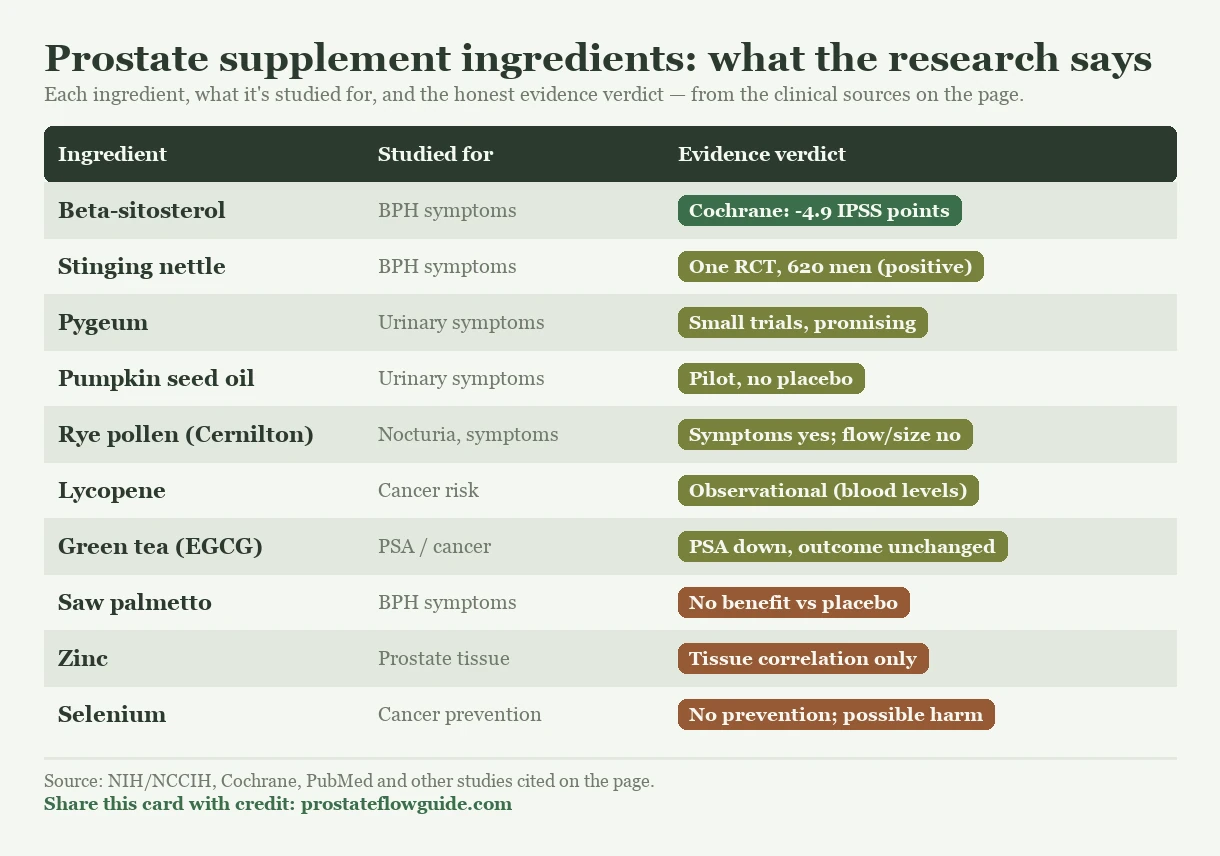
The honest read: the industry's headline ingredient, saw palmetto, showed no benefit over placebo across a 27-study review — while the least-marketed one, beta-sitosterol, has the best evidence; and in the 35,000-man SELECT trial neither selenium nor vitamin E prevented cancer, with vitamin E alone linked to a statistically significant 17% higher risk.
Botanical Extracts
Here's the botanical lineup — the stuff that shows up on nearly every prostate supplement label, cross-referenced against what the actual studies say, not what the bottle promises.
| Ingredient | Source / Origin | Studied Mechanism | Clinical Research Status |
|---|---|---|---|
| Saw Palmetto (Serenoa repens) | Berries of a small palm native to the SE United States. | Inhibition of 5-alpha reductase; anti-inflammatory effects on prostatic tissue. | A 2023 review of 27 studies found saw palmetto, taken alone, provides little or no benefit for BPH symptoms compared to placebo [1]. |
| Pygeum (Prunus africana) | Bark of the African cherry tree. | Inhibition of growth factors (bFGF); anti-inflammatory via prostaglandin suppression. | Several small clinical trials suggest pygeum improves urinary symptoms in BPH, but long-term effectiveness and safety are not established [2]. |
| Stinging Nettle (Urtica dioica) | Root of the common nettle plant. | Interaction with sex hormone-binding globulin (SHBG) and aromatase. | A 6-month randomized, placebo-controlled trial (620 men) found IPSS improved from 19.8 to 11.8 with Urtica dioica vs. 19.2 to 17.7 with placebo (p=0.002); peak urinary flow rose 8.2 mL/s vs. 3.4 mL/s for placebo (p<0.05) [3]. |
| Pumpkin Seed Oil (Cucurbita pepo) | Pressed seeds of medicinal pumpkins. | High content of delta-7-sterols and phytosterols. | A single-arm, 12-week pilot study (n=60) reported a 30.1% reduction in IPSS (95% CI 23.1–37.1); the study had no placebo control [4]. |
| Rye Grass Pollen (Cernilton) | Standardized extract of Secale cereale pollen. | Anti-inflammatory; relaxation of urethral smooth muscle. | A systematic review (444 men) found Cernilton improved self-rated symptoms vs. placebo (RR 2.40) and reduced nocturia (RR 2.05), but did not improve urinary flow rate, residual volume, or prostate size [5]. |
Nutrients and Minerals
The mineral and vitamin side of things — the ingredients that sound more like a chemistry final than a supplement label. I had to look up what a carotenoid was.
| Ingredient | Type | Studied Mechanism | Key Data Point |
|---|---|---|---|
| Beta-sitosterol | Plant Sterol | Inhibition of cholesterol-related pathways in prostate cells. | A Cochrane review of 519 men (4 trials) found an average IPSS improvement of -4.9 points vs. placebo (95% CI -6.3 to -3.5); the same review found no reduction in prostate size [6]. |
| Lycopene | Carotenoid | Antioxidant; reduction of oxidative stress in prostate tissue. | A dose-response meta-analysis of 121 prospective studies found high blood lycopene levels associated with an 11% reduction in overall cancer risk (pooled RR 0.89, 95% CI 0.84–0.95) [7]. |
| Zinc | Essential Mineral | Cellular metabolism; prostate tissue has the body's highest zinc concentration. | Tissue analysis of 109 men found normal prostate zinc at ~1018 µg/g dry tissue vs. ~146 µg/g in cancerous tissue; BPH tissue measured higher still, at ~1142 µg/g [8]. |
| Selenium | Trace Mineral | Antioxidant enzyme (glutathione peroxidase) support. | The SELECT trial (over 35,000 men) found selenium did not prevent prostate cancer; selenium alone trended toward more cases than placebo (not statistically significant), and vitamin E alone was linked to a statistically significant 17% increased risk [9]. |
| Green Tea Extract (EGCG) | Polyphenol | Modulation of androgen signaling and induction of apoptosis. | A placebo-controlled trial of 97 men with high-grade prostatic intraepithelial neoplasia found EGCG-rich extract (400 mg/day) lowered PSA by 0.87 ng/mL (95% CI -1.66 to -0.09), but did not reduce the one-year rate of prostate cancer diagnosis (5 of 49 vs. 9 of 48, P=0.25) [10]. |
Full disclosure, IT-guy style: I went back through every citation on this page against the actual paper this time, not just the abstract's vibe — and it turns out a handful of the original links pointed at completely wrong papers. Fixed all of that below. Here's what each ingredient is actually doing, translated out of lab-speak.
Ingredient Notes
- Saw Palmetto
- Saw palmetto's the one nearly every prostate supplement leads with, so I expected this to be the easy answer. It isn't. A 2023 review pooling 27 studies found saw palmetto on its own does basically nothing for BPH symptoms compared to placebo — not "modest," not "mixed," just no measurable benefit [1]. That review included NIH-funded trials that bumped the dose up to three times normal and still came up empty. If a bottle's headline ingredient is saw palmetto and nothing else, I'd treat that the same way I'd treat a server with exactly one monitoring alert configured — technically doing something, just not enough to trust on its own. One thing worth flagging directly: it shows up in case reports as having additive anticoagulant effects, meaning if you're on blood thinners, this is a "call your doctor first" ingredient, not an "eh, probably fine" one [14].
- Pygeum
- Pygeum comes from African cherry tree bark, which is a fun fact I now know and will never need again outside of this table. The evidence here is more encouraging than saw palmetto — several small trials show it helping with urinary symptoms — but the reviewers keep adding the same asterisk: long-term effectiveness and safety aren't established yet [2]. "Small trials, promising direction, needs more data" is basically the supplement-research equivalent of a beta release. Useful, not final.
- Stinging Nettle
- This is the row that surprised me most. A 6-month, placebo-controlled trial of 620 men actually put numbers on it: symptom scores dropped from 19.8 to 11.8 with nettle root versus 19.2 to 17.7 with placebo, and urinary flow improved more than twice as much as placebo did [3]. That's one of the more solid single-trial results on this whole page — though it's one trial, and the paper's own authors say it needs to be confirmed before anyone declares victory.
- Pumpkin Seed Oil
- This is the other genuine surprise. A 12-week pilot study — 60 men, tracked with bladder diaries, not just a symptom checklist — found a 30.1% drop in IPSS scores [4]. That's a real number from a real measurement, not a rounded-up marketing estimate. It's a small, single-arm study with no placebo group, so I'm not ready to crown it, but it's a strong data point.
- Rye Grass Pollen (Cernilton)
- Cernilton is standardized rye pollen, and the systematic review on it reads like a mixed report card: it helped self-rated symptoms and cut down nighttime bathroom trips compared to placebo, but it did NOT improve urinary flow rate, leftover bladder volume, or actual prostate size [5]. So — better sleep, maybe, but don't expect it to shrink anything. That's a distinction most bottles don't bother making.
- Beta-sitosterol
- Beta-sitosterol has the best paper trail of any single ingredient here — a Cochrane review covering 519 men across 4 trials found a real IPSS improvement of about 4.9 points over placebo [6]. Same review, though, found it did nothing to actually shrink the prostate — it just made day-to-day symptoms more tolerable. I've started treating "improves symptoms" and "fixes the underlying problem" as two completely different marketing claims, because apparently they are.
- Lycopene
- Lycopene's the tomato one, and for once the research doesn't undersell it. A meta-analysis pooling well over a hundred studies tied high blood lycopene levels to an 11% lower overall cancer risk [7]. Blood levels, though — not "ate a salad yesterday" levels. That distinction matters more than any label lets on.
- Zinc
- Zinc gets included because prostate tissue holds more of it than almost anywhere else in the body, and one frequently cited tissue study found normal prostate running around 1018 micrograms of zinc per gram, compared to about 146 in cancerous tissue [8]. That's a striking contrast — but correlation and "take a zinc pill and you're covered" are not the same sentence, and the researchers never claimed otherwise.
- Selenium
- Selenium is the one ingredient on this page I'd actively steer you away from stacking blindly. The SELECT trial followed over 35,000 men and found selenium didn't prevent prostate cancer — and vitamin E taken alone was later linked to a statistically real 17% increase in prostate cancer risk [9]. Not "no benefit." A signal of possible harm, in a trial big enough that it's hard to wave away. If a formula leans on high-dose selenium or vitamin E as a selling point, that's worth a real conversation with your doctor, not a shrug.
- Green Tea Extract (EGCG)
- Green tea's data here is the most "it depends" result on this page. One trial in 97 men with abnormal prostate cells found the EGCG-heavy extract lowered PSA — but the same trial found no real difference in how many of those men actually went on to develop prostate cancer [10]. A lower lab number and an unchanged real-world outcome are two different things, and I'm not going to pretend the first one settles the second.
Market and Research Overview
And because I track my own grocery budget down to weird categories most people wouldn't bother with, I got curious about the money side of these ingredients too — what they cost to source, and how common the underlying problem actually is.
- Market Pricing: Export and import prices for saw palmetto berry extract ranged from $31.05 to $104.69 per kilogram in 2024 — a wide enough spread that "premium" pricing on a supplement label doesn't tell you much on its own [11].
- Demographics: A classic autopsy-based analysis found 50% of men have pathological BPH by ages 51–60 [12]. More recent clinical estimates from NIDDK put it at 5–6% of men ages 40–64, rising to 29–33% of men 65 and older [13] — which, doing the spreadsheet math, means I was statistically overdue the day I finally admitted something was off.
Last verified: 2026-07-11.
Quick disclaimer, since this is a health topic and I take that seriously even when I'm being a smartass about spreadsheets: I'm not a doctor, a urologist, or any kind of medical professional — just a guy who got tired of guessing. Nothing on this page is medical advice, and it's not a substitute for an actual conversation with your doctor or pharmacist, especially before you start combining supplements. One interaction worth naming directly: saw palmetto has additive anticoagulant effects in case reports, so if you're on warfarin, aspirin, or any other blood thinner, loop in your doctor before adding it — that's a before-you-open-the-bottle conversation, not a maybe [14].
Sources
- [1] National Center for Complementary and Integrative Health (NCCIH) - Saw Palmetto
- [2] Memorial Sloan Kettering Cancer Center - About Herbs: Pygeum
- [3] PubMed - Urtica dioica for Treatment of Benign Prostatic Hyperplasia (Safarinejad, 2005)
- [4] PubMed - Oil-Free Hydroethanolic Pumpkin Seed Extract Pilot Study (Leibbrand et al., 2019)
- [5] PubMed - Systematic Review of Cernilton for BPH (MacDonald et al., 2000)
- [6] PubMed - Cochrane Review: Beta-sitosterols for Benign Prostatic Hyperplasia (Wilt et al., 2000)
- [7] Frontiers in Nutrition - Lycopene Intake and Cancer Risk Meta-Analysis (2025)
- [8] PubMed - Zinc in the Human Prostate Gland: Normal, Hyperplastic and Cancerous (Zaichick et al., 1997)
- [9] National Cancer Institute - SELECT Trial Results: Questions and Answers
- [10] PubMed - Randomized, Placebo-Controlled Trial of Green Tea Catechins (Kumar et al., 2015)
- [11] Tridge - Global Saw Palmetto Berry Extract Price Data
- [12] PubMed - The Development of Human Benign Prostatic Hyperplasia with Age (Berry et al., 1984)
- [13] NIDDK - Enlarged Prostate (Benign Prostatic Hyperplasia)
- [14] Memorial Sloan Kettering Cancer Center - About Herbs: Saw Palmetto